
 Send Inquiry


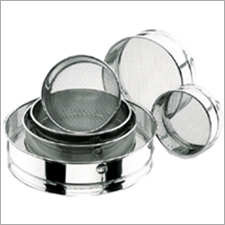
Standard Test Sieves
50000.00 - 100000.00 INR/Piece
Product Details:
- Accuracy Compliant with ASTM E11, ISO 3310-1
- Mounting Type Stackable
- Humidity Max. 85% (non-condensing recommended)
- Operating Voltage Not applicable (unless used with sieve shaker)
- Response Time Immediate (manual)
- Application Particle Size Analysis, Laboratory Testing, Quality Control
- Features Stainless steel mesh and frame, Brass frame options, Serialized, Certificate of Conformance
- Click to view more
X
Standard Test Sieves Price And Quantity
- 1 Piece
- 50000.00 - 100000.00 INR/Piece
Standard Test Sieves Product Specifications
- Manual or mechanical shakers
- Stainless steel mesh and frame, Brass frame options, Serialized, Certificate of Conformance
- Material hardness dependent (Stainless steel, Brass)
- Varies by sieve size and sample
- As per IS/BS/ASTM standards
- Particle Size Analysis, Laboratory Testing, Quality Control
- Immediate (manual)
- Not applicable (unless used with sieve shaker)
- Wet & Dry Sieving
- Max. 85% (non-condensing recommended)
- Manual operation
- Compliant with ASTM E11, ISO 3310-1
- Stackable
- 3.5 kg (approx. per sieve stack)
- 200 mm (8 inch diameter standard)
- Microns to millimeters depending on sieve mesh
- One stack per test
- 20 micron to 100 mm
- Up to 480 mm (stack height depending on model)
- 20 micron to 100 mm (mesh openings)
- 5°C to 40°C operating
- Not required for manual use
- Up to 2 kg sample material
- Manual
- 8 inch, 12 inch, 18 inch diameters also available
- Standard Test Sieve
- Laser etched mesh and serial number
- ASTM E11, ISO 3310-1/2/3, IS 460
- Stainless Steel (Standard), also available in Brass or Phosphor Bronze
- Ultrasonic/vacuum cleaning recommended
- Deep drawn & seamless for durability
- Supplied with lid and receiver upon request
- Full Height ~50 mm, Half Height ~25 mm
Standard Test Sieves Trade Information
- 100 Piece Per Week
- 5-7 Days
- All India
Product Description
Owing to our rich industry experience, we are offering Standard Test Sieves, which are a screening medium, with openings of uniform size and shape, mounted on a rigid frame. These Standard Test Sieves are designed at par with the quality standards and uses metal cloth with holes in it to separate some kind of particles from materials. We are offering these sieves in number of specifications as per the needs of customers.
Superior Material and Construction
Standard Test Sieves are manufactured from high-quality stainless steel for both the mesh and frame, although brass and phosphor bronze options are available. The deep-drawn, seamless frame design enhances durability and lifespan. Each sieve is laser etched with mesh and serial numbers, ensuring precise identification and traceability for certified laboratory work.
Certified for Accuracy and Compliance
Compliant with globally recognized standards such as ASTM E11, ISO 3310-1/2/3, and IS 460, these test sieves guarantee trustworthy results for particle size analysis. Each product is supplied with a Certificate of Conformance, supporting the needs of laboratories, quality control, and manufacturing industries seeking assured measurement standards.
Versatile Application and Easy Maintenance
Designed for both wet and dry sieving applications, these sieves are ideal for a vast range of particle size analyses. Their stackable design allows for various configurations, accommodating sample retention with optional lids and receivers. Maintenance is effortless, as ultrasonic and vacuum cleaning methods are recommended to ensure longevity and high hygiene standards.
FAQ's of Standard Test Sieves:
Q: How are Standard Test Sieves used in particle size analysis?
A: Standard Test Sieves are used by stacking multiple sieves of sequential mesh sizes, loading a sample (up to 2 kg depending on model), and either manually or mechanically shaking the stack. This process separates particles based on size, enabling accurate quality control and laboratory testing.Q: What mesh materials are available and how do I choose?
A: Test sieves are offered in stainless steel as the standard mesh material, but are also available in brass or phosphor bronze. Stainless steel is preferred for its durability and corrosion resistance, while brass or phosphor bronze may be selected for specific materials or compatibility needs.Q: When should a lid and receiver be used with sieves?
A: Lids and receivers are recommended when handling finer materials or when a complete retention of sample is necessary during wet or dry sieving. These accessories help prevent loss of sample and improve the efficiency of particle separation.Q: Where can these test sieves be applied?
A: Standard Test Sieves are suitable for laboratory testing, quality control processes, and particle size analysis across industries such as pharmaceuticals, construction, mining, and food processing. They are trusted by dealers, manufacturers, and exporters throughout India and worldwide.Q: What is the recommended process for cleaning and maintaining the sieves?
A: To maintain accuracy and extend the lifespan of your sieves, it is advised to clean them using ultrasonic or vacuum cleaning methods. These approaches ensure that the sieves remain free of residue and avoid damage to the mesh.Q: What are the key benefits of using these sieves?
A: Key benefits include precise particle size determination, compliance with international standards, robust construction for extended use, traceable serial numbers, and versatility for wet or dry sieving applications. Their manual operation requires no power supply unless used with mechanical shakers.Q: What are the available sizes and capacities for these sieves?
A: Standard Test Sieves are available in 8 inch (200 mm), 12 inch, and 18 inch diameters, with full or half heights. They can test sample sizes up to 2 kg, with a measuring range from 20 microns to 100 mm, depending on mesh size and application.Tell us about your requirement

Price:
Quantity
Select Unit
- 50
- 100
- 200
- 250
- 500
- 1000+
Additional detail
Mobile number
Email

Other Products in 'Soil Testing Equipment' category


Contact Details

- B No. 51, Rama Road Industrial Area, New Delhi - 110015, India
ACCURATE SCIENTIFIC INTERNATIONAL
GST : 07ADUPA7135P1ZY
GST : 07ADUPA7135P1ZY

- Mr Parth Anand (Business Development Manager)
- Mobile : +919810080693, +919599580698
- accuratescientific51@gmail.com
- Branch Address : 1805 E Gwen Street, Phoenix, Arizona 85042
 Send Inquiry
 Send SMS
ACCURATE SCIENTIFIC INTERNATIONAL
All Rights Reserved.(Terms of Use)
Developed and Managed by Infocom Network Private Limited.
Developed and Managed by Infocom Network Private Limited.

