
 Send Inquiry


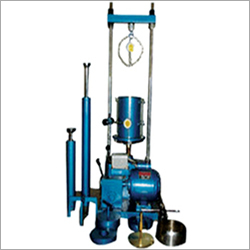
C.B.R Testing Apparatus
Product Details:
- Test Range 0-50 kN
- Mounting Type Tabletop
- Material Mild Steel
- Specimen Size 150mm dia x 175mm height Millimeter (mm)
- Frequency 50 Hertz (HZ)
- Color Blue
- Display Type Analog/Dial Gauge
- Click to view more
X
C.B.R Testing Apparatus Price And Quantity
- 1 Piece
C.B.R Testing Apparatus Product Specifications
- 230V AC, 50Hz
- Laboratory Soil Testing Apparatus
- Detachable Components, Corrosion-Resistant Finish
- Single Specimen
- Industrial
- California Bearing Ratio Test (CBR) for Soil/Construction Materials
- 0.01 kN
- Approx. 500 mm
- C.B.R Testing Apparatus
- Manual/Mechanical
- Manual
- 230 Volt (V)
- 50 mm
- 0-90% RH (Operating Conditions)
- ± 0.5 %
- Standard Mild Steel Hardness
- 10°C to 40°C Celsius (oC)
- 1.25 mm/min
- Analog/Dial Gauge
- Blue
- 150 Millimeter (mm)
- 150mm dia x 175mm height Millimeter (mm)
- 50 Hertz (HZ)
- Approx. 70-85 Kilograms (kg)
- Mild Steel
- Tabletop
- 0-50 kN
- 50 kN or 5000 kg
- Cutting Collar, Spacer Disc, Annular and Perforated Base Plate, Rammer
- IS: 2720 (Part XVI)
- 50 mm
- 175 mm
- Penetration Measurement Under Load
- Mechanical Dial Reading Indicator
C.B.R Testing Apparatus Trade Information
- 100 Piece Per Week
- 7-10 Days
- All India
Product Description
Backed by a diligent team of professionals, we have been able to provide C.B.R Testing Apparatus, which is demanded to find the strength of subgrade soil and highway sub base and subgrade via a penetration test. To ensure defect free, the C.B.R Testing Apparatus is rigorously tested upon a series of parameters. Moreover, we offer this apparatus in several specifications as per the requirement of our customers.
Accurate Soil Strength Evaluation
Designed for conducting the California Bearing Ratio (CBR) test, this apparatus provides reliable measurements of soil bearing strength. It accommodates a single specimen with dimensions of 150mm diameter by 175mm height and delivers precision readings through its mechanical dial gauge, with a resolution of 0.01 kN. Laboratories and industrial users benefit from its robust mild steel construction and corrosion-resistant finish, ensuring longevity even under intense usage.
Easy Operation and Maintenance
Engineered with user convenience in mind, this apparatus features a manual/mechanical control mode and detachable components for straightforward operation and cleaning. Its tabletop mounting and compact design allow for easy installation in laboratory environments. Standard accessories, including a spacer disc and rammer, ensure seamless specimen preparation and testing in compliance with IS: 2720 (Part XVI).
Reliable Performance Across Conditions
With an operating voltage of 230V AC and a frequency of 50Hz, the device is suitable for Indian laboratory standards. Its operational range spans 10C to 40C and 0-90% relative humidity, delivering consistent results in diverse environments. The 1.25 mm/min test speed and 50 mm test stroke guarantee accurate penetration measurement under load, yielding instantaneous response times for efficient laboratory workflows.
FAQs of C.B.R Testing Apparatus:
Q: How is the C.B.R Testing Apparatus used in soil testing?
A: The C.B.R Testing Apparatus is primarily used to measure the California Bearing Ratio of soil or construction materials. The soil sample, prepared and placed in the mould, is penetrated by a 50 mm plunger under a controlled load. The mechanical dial gauge measures the resistance of the soil to penetration, providing data to assess its suitability for road and pavement subgrades.Q: What process should be followed when operating this apparatus?
A: Begin by assembling the mould with the cutting collar, annular base plate, and other standard accessories. Prepare the soil specimen to the specified size and place it in the mould. Mount the mould on the apparatus and align the plunger. Begin the test at the designated speed of 1.25 mm/min, recording penetration readings from the dial gauge until the required stroke or resistance is achieved.Q: Where can this C.B.R Testing Apparatus be installed and operated?
A: This apparatus is designed for laboratory use and can be mounted on any stable tabletop. It is widely used in geotechnical, civil engineering, and construction material testing laboratories in India. The equipment operates under typical lab conditions: 10C to 40C temperature and 0-90% relative humidity.Q: What are the benefits of using this manual/mechanical C.B.R Testing Apparatus?
A: The benefits include high accuracy (0.5%), real-time readings via the analog dial indicator, durable mild steel construction, and corrosion resistance. The manual/mechanical system makes it easy to use, maintain, and service, and it supports reliable measurements without the need for complex electronics or calibration procedures.Q: When is this apparatus most frequently used during construction projects?
A: The C.B.R Testing Apparatus is typically used during the preliminary soil investigation stage and quality assessment phases of road, runway, and pavement construction projects. Lab technicians utilize it to determine soil strength before finalizing designs and selecting suitable materials.Q: How does the reading unit function in this equipment?
A: The apparatus features a mechanical dial reading indicator, providing direct and instantaneous measurement of the resistance encountered by the plunger during penetration. This allows for straightforward and precise data collection during the CBR test procedure.Tell us about your requirement

Price:
Quantity
Select Unit
- 50
- 100
- 200
- 250
- 500
- 1000+
Additional detail
Mobile number
Email

Other Products in 'Soil Testing Equipment' category


Contact Details

- B No. 51, Rama Road Industrial Area, New Delhi - 110015, India
ACCURATE SCIENTIFIC INTERNATIONAL
GST : 07ADUPA7135P1ZY
GST : 07ADUPA7135P1ZY

- Mr Parth Anand (Business Development Manager)
- Mobile : +919810080693, +919599580698
- accuratescientific51@gmail.com
- Branch Address : 1805 E Gwen Street, Phoenix, Arizona 85042
 Send Inquiry
 Send SMS
ACCURATE SCIENTIFIC INTERNATIONAL
All Rights Reserved.(Terms of Use)
Developed and Managed by Infocom Network Private Limited.
Developed and Managed by Infocom Network Private Limited.

