
 Send Inquiry


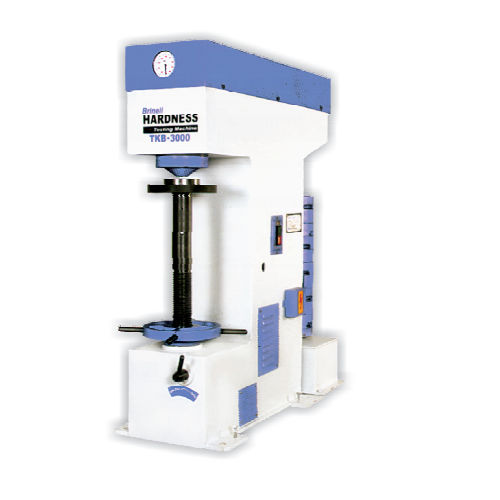
Brinell Hardness Tester
145000 INR/Piece
Product Details:
- Number of Specimens 1
- Power 440 Volt (v)
- Color Blue & White
- Power Supply 440V AC
- Material Casting
- Product Type Manual
- Machine Weight 200 Kilograms (kg)
- Click to view more
X
Brinell Hardness Tester Price And Quantity
- 1 Piece
- 145000 INR/Piece
Brinell Hardness Tester Product Specifications
- 200 Kilograms (kg)
- 1
- Casting
- Manual
- 440V AC
- Blue & White
- 440 Volt (v)
- Manual
Brinell Hardness Tester Trade Information
- Cash in Advance (CID), Cheque, Cash Advance (CA)
- 15-20 Piece Per Day
- 1-2 Days
- Wooden Box
- Africa, Australia, North America, South America, Eastern Europe, Western Europe, Middle East, Asia, Central America
- All India
Product Description
Brinell Hardness Tester
- This machine is designed for Brinell Hardness measurement on steel & other ferrous materials & also on non-ferrous materials like Brass, Bronze, Aluminum, etc. The material can be cast, forged or rolled & the shape can be flat, round or irregular.
- This machine is specially used in production testing. Its stability & unique design of a floating fulcrum lever system ensure high accuracy & dependability.
- The load application system is of dead weight type combined with mechanical lever system. The supporting hydraulic system is for initial lifting of load before each test & damping the load application system for smooth application of load.
- Test loads from 500 to 3000 kgf in steps of 250kgf.
- The height X Throat is 380 X 200 mm.
- Indentation measurement by Brinell Microscope of 25 X Magnification.
- Manual / Optical / Computerized type Brinell Hardness testing machines are also available.
- Accuracy conforms to IS:2281-2005 & BS:240.
| Load (kgf) | 500 to 3000 in steps of 250 |
| Initial load (Kgf) | NIL |
| Maximum test Height x Throat (mm) | 380 x 200 |
| Maximum depth of elevating screw below base (mm) approx. | 180 |
| Machine height (mm) approx | 1250 |
| Size of base (mm) approx | 400 x 740 |
| Net weight (Kg) approx | 400 |
| Drive motor (hp) | 0.5 |
| Mains supply | 3 Phase, 415V, 50 Hz, AC |
| Flat testing table dia 200 mm | 1 No |
| Groove testing table dia 70 mm for round jobs of dia 10 to 80 mm | 1 No |
| Ball holder dia 5 mm | 1 No |
| Ball holder dia 10 mm | 1 No |
| Test Block HBW 5/750 | 1 No |
| Test Block HBW 10/3000 | 1 No |
| Allen key set | 4 -pieces |
| Tungsten Carbide ball dia 5 mm | 1 No |
| Tungsten Carbide ball dia 10 mm | 1 No |
| Indentation Measurement | 1 Book |
| Brinell Microscope | 1 No |
Reliable Performance for Casting Hardness Testing
Engineered specifically for evaluating the hardness of casting materials, this Brinell Hardness Tester ensures accuracy and repeatability. Its sturdy construction and 440V AC operation enable stable performance, making it a dependable solution for fabrication industries and research labs seeking consistent quality checks.
Manual Control for Precision Assessment
Featuring an intuitive manual control mode, operators can precisely manage testing parameters for each specimen. This design fosters adaptability, enabling users to accommodate unique requirements and minimize operator errors during hardness determination.
Widespread Availability in India
As a product supported by various suppliersincluding dealers, distributors, exporters, and manufacturersthis Brinell Hardness Tester is easily accessible throughout India. Its versatile distribution network ensures prompt delivery and responsive after-sales support for customers nationwide.
FAQs of Brinell Hardness Tester:
Q: How is the Brinell Hardness Tester used to measure casting hardness?
A: The tester operates by pressing a hardened steel or carbide ball into the surface of the casting specimen under controlled load and measuring the indentation, which determines the materials Brinell Hardness Number (BHN).Q: What types of power supply are required to operate this machine?
A: This Brinell Hardness Tester is designed to run on a 440 Volt alternating current (AC) power supply, making it suitable for industrial environments in India where this voltage is standard.Q: Where can I purchase or source this Brinell Hardness Tester in India?
A: You can procure this tester through an extensive network of dealers, distributors, exporters, manufacturers, suppliers, traders, and wholesalers across India, ensuring you have multiple options for procurement and support.Q: When should this hardness tester be used in the manufacturing process?
A: It is best utilized after casting but before final machining or product dispatch, so that any deviations in hardness are detected early, which allows for process adjustments or quality rejections.Q: What is the process for testing a specimen using this machine?
A: Place the casting specimen in the holder, ensure the machine is powered (440V AC), and manually operate the control to press the indenter into the material. The resulting indentation is then measured to calculate the hardness.Q: What are the benefits of using a manual control mode on this tester?
A: Manual control offers enhanced operator oversight during testing, providing flexibility for varied specimen types and helping to reduce the chance of automated errors, ultimately leading to highly reliable measurements.Tell us about your requirement

Price:
Quantity
Select Unit
- 50
- 100
- 200
- 250
- 500
- 1000+
Additional detail
Mobile number
Email

Other Products in 'Hardness Testing Machine' category


Contact Details

- B No. 51, Rama Road Industrial Area, New Delhi - 110015, India
ACCURATE SCIENTIFIC INTERNATIONAL
GST : 07ADUPA7135P1ZY
GST : 07ADUPA7135P1ZY

- Mr Parth Anand (Business Development Manager)
- Mobile : +919810080693, +919599580698
- accuratescientific51@gmail.com
- Branch Address : 1805 E Gwen Street, Phoenix, Arizona 85042
 Send Inquiry
 Send SMS
ACCURATE SCIENTIFIC INTERNATIONAL
All Rights Reserved.(Terms of Use)
Developed and Managed by Infocom Network Private Limited.
Developed and Managed by Infocom Network Private Limited.

