
 Send Inquiry


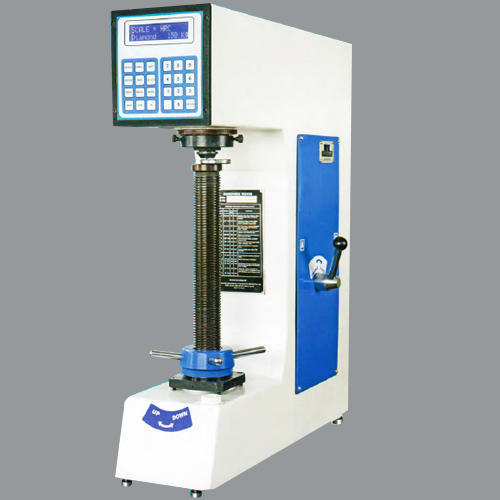
Digital Rockwell Hardness Tester
125000 INR/Piece
Product Details:
- Number of Specimens Single
- Application Metal Hardness Testing
- Test Range 20HRB to 100HRC
- Operating Voltage 230 VAC
- Equipment Type Digital Rockwell Hardness Tester
- Humidity 80% RH
- Max Height 200 mm
- Click to view more
X
Digital Rockwell Hardness Tester Price And Quantity
- 1 Piece
- 125000 INR/Piece
Digital Rockwell Hardness Tester Product Specifications
- RS232 / USB
- Approx 150 mm
- 0.2 HRC
- 50 Hz
- Standard - 6 mm
- 0 to 100 HRC
- Rockwell A, B, C digital display
- Up to 200 mm
- Digital LCD
- <2 seconds
- Adjustable 0.5 mm/sec to 2 mm/sec
- Approx 60 Kg
- 0.1 HRC
- Bench-top
- Automatic
- 100 kgf Max
- Single
- Industrial / Laboratory
- Metal Hardness Testing
- 20HRB to 100HRC
- 230 VAC
- Digital Rockwell Hardness Tester
- 80% RH
- 200 mm
- 20 mm to 150 mm
- 10C to 40C operating
- Automatic load/unload, Data output, Error alert
- 230V AC 10%, 50 Hz
- Digital/Automatic
- Overload & Emergency Stop
- Adjustable (1-99s)
- 60, 100, 150 kgf selectable
- Up to 1000 results
- 580 x 250 x 800 mm
- Diamond Cone & Steel Ball
- Optional PC software for analysis
- Automatic & Manual
- Microprocessor controlled
- Industrial Grey
Digital Rockwell Hardness Tester Trade Information
- Cheque
- 15-20 Piece Per Month
- 1-2 Days
- Western Europe, North America, Eastern Europe, Middle East, Central America, South America, Asia, Australia, Africa
- All India
Product Description
Digital Rockwell Hardness Tester
- This machine is designed for measuring hardness of metals & alloys of all kinds, hard or soft, whether round,flat or irregular in shapes.
- Semi-automatic, motorized, digital, microprocessor based panel. We can get hardness in digital version.
- Centronics parallel port for connecting dot matrix printer.
- Three modes of operation viz. Motorized automatic mode, Motorized mode& Manual mode.
- Automatic weight selection by thumb wheel.
- Test height x Throat is - 295 x 148 mm.
- Machines strictly conforms to IS:1586 / 2281, BS: 240, ASTM-E-10
| MODELS | ASI-RHTD |
| Test Loads (kgf) | 60, 100, 150 (Rockwell) |
| Initial Loads (kgf) | 10 |
| Max. Test Height (mm) | 295 |
| Depth of Throat (mm) | 148 |
| Max. depth of elevating screw below base (mm) | 290 |
| Overall Dimensions(LXWXH) (mm) (Approx.) | 580 x 270 x 915 |
| Nett. Wt. Approx. (kg) | 110 |
| cales Displayed | Rockwell A, B, C, D, E, F, G, H, K, M, P, R, S, V, L in Nos. 1 to 15 resp. |
| Least Count | 0.1 |
| Minor Load Setting | By Bar Graph Indicator (Manual Setting) |
| Load Control | Automatic (Loading, Dwell, Unloading for major load) |
| Dwell Time | 1 to 99 seconds selectable |
| Printer Interface | Centronics Parallel Port to connect Dot Matrix Printer |
| Power Supply | 220 V, Single Phase, 50 Hz, AC, (3 Wire System) |
STANDARD ACCESSORIES
| Rockwell Diamond Indentor | 1 No. |
| Testing Table f 50 mm | 1 No. |
| Testing Table f40 mm with V Groove for round Jobs f6 to 45 mm | 1 No. |
| Steel Ball Indentor f1/16 | 1 No. |
| Test Block HRC | 1 No. |
| Test Block HRB | 1 No. |
| Steel Ball f1/16 | 5 Nos. |
| Allen Spanners | 3 Nos. |
| Clamping Device | 1 No. |
| PVC Cover for Machine | 1 No. |
| Rubber Bellow | 1 No. |
| Instruction Manual | 1 Book |
Precision Metal Hardness Testing
Engineered for industrial and laboratory use, this Digital Rockwell Hardness Tester delivers high-accuracy hardness measurements with digital automation and selectable force, indenter, and dwell time settings. The advanced microprocessor control and digital display facilitate simple operation and quick results, making it ideal for quality control and research applications.
Automatic and Manual Calibration
Users benefit from both automatic and manual calibration features, ensuring consistent accuracy and flexibility to adapt to varying specimen types. This function is integral for maintaining reliable measurements over repeated use in demanding environments.
Comprehensive Data Handling
Storing up to 1000 results and equipped with RS232/USB interfaces, the tester streamlines data export and analysis. Optional PC software allows users to manage data efficiently, enhancing report generation for monitoring hardness trends over time.
FAQ's of Digital Rockwell Hardness Tester:
Q: How does the Digital Rockwell Hardness Tester ensure accurate hardness measurement?
A: The tester features automatic and manual calibration functions, selectable indenter types, and precise test force so users can tailor settings for different specimens. Its microprocessor control and digital LCD display deliver measurements with 0.2 HRC accuracy.Q: What is the process for conducting a hardness test with this equipment?
A: First, select the proper indenter and test force for the specimen. Place the specimen securely, choose dwell time, and initiate the test using the digital controls. The machine automatically loads and unloads, displaying the result promptly on its screen.Q: When is it beneficial to use adjustable dwell time and test speed?
A: Adjustable dwell time (1-99s) and test speed (0.5-2 mm/sec) are useful for optimizing testing conditions based on material properties, ensuring reliable hardness readings especially when working with diverse metals or alloys.Q: Where can the Digital Rockwell Hardness Tester be installed?
A: Its bench-top design makes it suitable for industrial laboratories, manufacturing floors, and quality control departments. The machine's compact size fits standard workstations, offering flexibility in various environments.Q: What are the advantages of using this tester in a laboratory or industrial setting?
A: Users gain rapid response times (<2 seconds), automated testing, broad measuring range, and extensive data storage. Enhanced safety features and reliable operation facilitate efficient quality control and minimize downtime.Q: How does optional PC software support analysis?
A: Optional PC software enables seamless data export, storage, and advanced report generation. Users can track hardness trends, organize results, and integrate test data into broader quality management or research systems.Q: What safety measures are included in the machine?
A: Safety features include overload protection and an emergency stop function, which help prevent damage to both the tester and specimens, ensuring safe operation and protecting users in case of test abnormalities.Tell us about your requirement

Price:
Quantity
Select Unit
- 50
- 100
- 200
- 250
- 500
- 1000+
Additional detail
Mobile number
Email

Other Products in 'Hardness Testing Machine' category


Contact Details

- B No. 51, Rama Road Industrial Area, New Delhi - 110015, India
ACCURATE SCIENTIFIC INTERNATIONAL
GST : 07ADUPA7135P1ZY
GST : 07ADUPA7135P1ZY

- Mr Parth Anand (Business Development Manager)
- Mobile : +919810080693, +919599580698
- accuratescientific51@gmail.com
- Branch Address : 1805 E Gwen Street, Phoenix, Arizona 85042
 Send Inquiry
 Send SMS
ACCURATE SCIENTIFIC INTERNATIONAL
All Rights Reserved.(Terms of Use)
Developed and Managed by Infocom Network Private Limited.
Developed and Managed by Infocom Network Private Limited.

