
 Send Inquiry


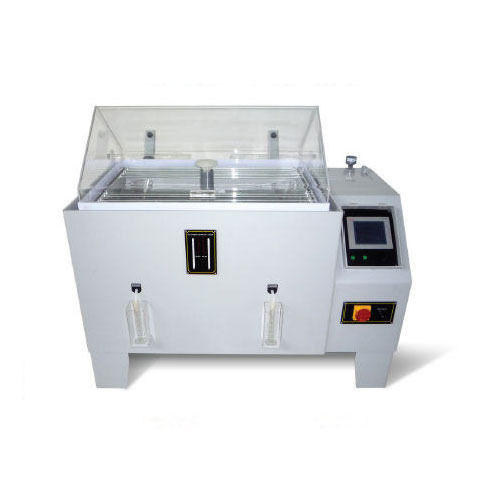
Cyclic Salt Spray Chamber
165000 INR/Piece
Product Details:
- Hardness Chamber Body: 65 HRC
- Mounting Type Floor Mounted
- Test Range Dry, Wet, Humid, Salt Spray, Air Dry, Condensation
- Automation Grade Fully Automatic
- Accuracy 0.1C (Temperature), 2% RH (Humidity)
- Temperature Ambient to 50C (1C)
- Humidity 20% to 98% RH (Programmable)
- Click to view more
X
Cyclic Salt Spray Chamber Price And Quantity
- 1 Piece
- 165000 INR/Piece
Cyclic Salt Spray Chamber Product Specifications
- Laboratory/Industrial Corrosion Testing
- Dry, Wet, Humid, Salt Spray, Air Dry, Condensation
- Floor Mounted
- Chamber Body: 65 HRC
- 20% to 98% RH (Programmable)
- Fully Automatic
- 0.1C (Temperature), 2% RH (Humidity)
- Ambient to 50C (1C)
- Corrosion Testing of Coatings, Paints and Metals
- PLC Controlled with Touchscreen HMI
- 220V AC, 50Hz, Single Phase
- Digital Touchscreen Display
- <5 seconds
- 50 Hz
- Approx. 200 kg
- Up to 10 at a time (standard holders)
- Up to 150 x 70 x 5 mm
- Automatic Water Refilling, Overheat Protection, Programmable Test Cycles, Mist Dispersion Technology
- 220V AC
- 0.01C
- Salt Solution pH 6.5 to 7.2
- Customizable (Standard 600 mm)
- 1200 mm (Approx.)
- 1/2 inch (Compressed Air Inlet)
- Programmable (based on test cycle)
- Cyclic Salt Spray Chamber
- Adjustable up to 300 mm
- USB & RS232 (Data Logging)
- 2 to 6 Bar (Adjustable)
- 200 Liters (Chamber Volume)
- 304 Stainless Steel
- Silicone Gasket, Leak Proof
- Overheat, Overpressure, Automatic Water Level Detection
- Adjustable angle racks
- Ready for 5% NaCl, configurable
- Continuous / Intermittent, Customizable
- External with float valve, 20 Litres
- +5C to +35C
- Automatic with overflow protection
- ASTM B117, ISO 9227, JIS Z 2371, DIN 50021
- Transparent polycarbonate lid with gas strut
- Atomizing Corrosion Resistant
- Fiber Reinforced Plastic (FRP)
- 1~2 ml/80cm2/hour
Cyclic Salt Spray Chamber Trade Information
- Cheque
- 1-2 Week
- Western Europe, Australia, Eastern Europe, Central America, Africa, Middle East, South America, Asia, North America
- All India
Product Description
Salt Spray Test Chambers are used to test a product or material in ahighly corrosive environment for the purposes of evaluating the long-termeffects of salt on an object and its ability to withstand the effects ofcorrosion. Environmental test chambers evaluate product quality and reliabilityand identify manufacturing flaws and weaknesses in those products before theyare released to the general market. The test results recorded through theprocess of salt spray testing can show the process of product decay anddegradation and help predict the potential lifespan of a product or coating.Within the sealed test chamber, a salt-laden spray or a salt-fog (mainlysodium-chloride) is produced by a high-pressure nozzle to check the corrosionresistance of product coatings or coverings for products usually made fromsteel, brass and other metals. The metal object is normally hung from a rod orhook in order to expose the most surface area possible for testing purposes.Theprocess of salt spray testing is relatively cheap, quicker than other forms ofenvironmental testing and reasonably repeatable. Yet, replicating corrosion iscomplicated due to the susceptibility of it being further affected by otherexternal factors. Therefore, the test results and the predicted lifespan of amaterial may not be completely accurate, and so the design and construction ofthe salt spray test chambers need to be carefully considered. Industrystandards in terms of size, test duration, and procedure need to be understoodand met before undergoing testing. Salt chambers are typically approximatelyfifteen cubic feet, and yet larger custom designed chambers can be made too.Using a pressurized supply of salt-spray or fog leads to an accelerated rate ofcorrosion in objects and therefore testing time can vary from taking a fewminutes to a number of days depending on the type and detail of data required.
Product Details:
| Temperature Range | Ambient to +50 Deg C |
| Capacity | 270ltr |
| Saturated Temperature | Ambient to +65 C |
| Salt Spray Fall Out Rate | Adjustable from 0.5 to2.5ml per 80cm2 per hr |
| Standards Of Compliance | ASTM |
| Specimen Hanging Capacity | 2kg-4kg |
| Controller | Digital/Touch Panel |
| Timer | Programmable digital timer for pre-set time operation |
| Heater | Low density ceramic layer rope heaters |
| Chamber Material | Inner P.P. Outer Stainless Steel |
| Load | 2.5kw- 5kw |
| Air Supply | Clean dry & Oil free,4.0 to 6.0 bar |
| Insulation | Mineral wool |
| Mobility | Heavy duty castor wheels |
| Power Supply | 230V,Single Phase,50hz |
Advanced Corrosion Testing Solutions
Engineered for rigorous corrosion resistance evaluations, this Cyclic Salt Spray Chamber provides an optimal environment for simulating real-world exposure to salt, humidity, and condensation. Its programmable cycles, automatic mist dispersion, and PLC touchscreen interface allow tailored experiments aligning with global standards. Robust construction and safety mechanisms guarantee durability, accuracy, and operator safety, supporting extensive laboratory or industrial usage.
Customizability for Varied Applications
With customizable chamber widths, test strokes, and programmable parameters, the chamber adapts to diverse laboratory needs. Adjustable specimen racks and test cycles facilitate flexible testing for coatings, paints, and metal surfaces of different sizes and characteristics. The digital display and data logging (USB & RS232) streamline monitoring and documentation of every test, ensuring traceable, reliable results for research or quality assurance.
FAQs of Cyclic Salt Spray Chamber:
Q: How does the Cyclic Salt Spray Chamber simulate real-world corrosion environments?
A: The chamber uses programmable cycles to alternate between salt spray, humid, dry, and condensation conditions. Its atomizing corrosion-resistant nozzles, precise temperature (up to 50C), and humidity (2098% RH) settings replicate harsh weather and industrial atmospheres, adhering to ASTM B117, ISO 9227, and related standards.Q: What is the process for conducting a corrosion test with this chamber?
A: Begin by preparing and mounting up to 10 specimens on adjustable angle racks. Set test cycles, temperature, humidity, and spray parameters using the touchscreen HMI. The chamber automatically executes the programmed sequence, with mist dispersion and automatic drainage ensuring consistent conditions. Data can be logged via USB or RS232.Q: When should I use the Cyclic Salt Spray Chamber for material testing?
A: This chamber is ideal during product development, quality assurance, or material certification phases to assess corrosion resistance of coatings, paints, or metal substrates. It is also used for comparative studies and meeting regulatory or customer requirements in laboratory and industrial environments.Q: Where can this equipment be installed for optimal use?
A: The chamber is designed as floor-mounted equipment suitable for laboratories, industrial testing centers, or research and development facilities. Ensure adequate compressed air, power (220V AC, single-phase), and drainage connections for seamless operation.Q: What benefits does the PLC touchscreen and automation provide?
A: The PLC-controlled touchscreen enables easy setup, real-time monitoring, and automated execution of complex test cycles. Automation reduces operator intervention, minimizes human error, enhances safety through overheat/overpressure protection, and ensures repeatable, accurate results.Q: How is the salt solution managed and what capacity does the tank support?
A: A 20-litre external salt solution tank with a float valve supplies the chamber, ensuring continuous feed for consistent testing. The system is ready for a standard 5% NaCl solution, though concentration is configurable to meet specific test protocols.Tell us about your requirement

Price:
Quantity
Select Unit
- 50
- 100
- 200
- 250
- 500
- 1000+
Additional detail
Mobile number
Email

Other Products in 'Salt Spray Chamber' category

Contact Details

- B No. 51, Rama Road Industrial Area, New Delhi - 110015, India
ACCURATE SCIENTIFIC INTERNATIONAL
GST : 07ADUPA7135P1ZY
GST : 07ADUPA7135P1ZY

- Mr Parth Anand (Business Development Manager)
- Mobile : +919810080693, +919599580698
- accuratescientific51@gmail.com
- Branch Address : 1805 E Gwen Street, Phoenix, Arizona 85042
 Send Inquiry
 Send SMS
ACCURATE SCIENTIFIC INTERNATIONAL
All Rights Reserved.(Terms of Use)
Developed and Managed by Infocom Network Private Limited.
Developed and Managed by Infocom Network Private Limited.

