
 Send Inquiry


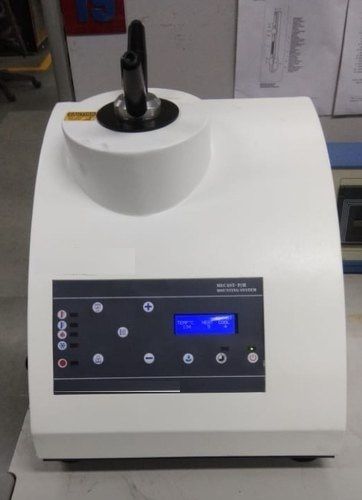
Automatic Mounting Press
140000 INR/Piece
Product Details:
- Equipment Type Automatic Mounting Press
- Frequency 50 Hz
- Gas Pressure Not Required (Electric Operation)
- Hardness Not Applicable (for mounting)
- Number of Specimens 1 or 2 per cycle
- Temperature Ambient, 1045C operating
- Operating Voltage 220V AC
- Click to view more
X
Automatic Mounting Press Price And Quantity
- 1 Piece
- 140000 INR/Piece
Automatic Mounting Press Product Specifications
- 2 seconds cycle time
- Feather Touch
- 220V AC
- Up to 2 samples / cycle
- Automatic Mounting Press
- 50 Hz
- 50 Kilograms (kg)
- Not Required (Electric Operation)
- Not Applicable (for mounting)
- 220V AC
- Ambient, 1045C operating
- 1 or 2 per cycle
- Automatic
- Metallographic Sample Mounting
- Simple Keypad / Digital Display
- Max. 40 mm (specimen)
- Adjustable, up to 180 mm/min
- Metallurgical Sample Preparation
- Digital (LED/LCD)
- 1050 mm diameter
- Up to 85% RH, non-condensing
- 1050 mm mounting diameter
- Automatic operation, digital display, programmable cycles, feather touch control
- Standard 1/4 BSP
- Tabletop
- 0.01 mm
- 0.1 mm
- 0150 mm
- 430 mm (with cover closed)
- 25 mm, 30 mm, and 40 mm diameter
- Thermal cut-off, door safety interlock, excess pressure relief
- Heat-resistant Bakelite or phenolic
- High-strength steel with non-stick coating
- 2-5 minutes per cycle
- 530 x 410 x 430 mm
- Industrial standard blue/grey
- 1000 W
- Automatic water-cooled or air-cooled cycle
- 0-200 bar (hydraulic)
Automatic Mounting Press Trade Information
- Cheque
- 1-2 Week
- Eastern Europe, Western Europe, Middle East, Central America, South America, Australia, Asia, North America, Africa
- All India
Product Description
AUTOMATIC SPECIMEN MOUNTING PRESS
This Machine is Automatic Mounting Press for metallographic specimen. It is suitable for all Thermosetting Materials, because of the cooling system. It can automatically finish with the heating temperature, the holding time and acting force. The operator can change 4 specification patterns according to the difficult specimens. It can make 2 specimens at one time.
SPECIFICATION:
- Pattern specimen : 25mm, 30mm, 40mm, 50mm
- Power: 220V 50Hz
- Maximum consumption: 1800W
- Pressure: 0~2Mpa
- Temperature: 0~300C
- Holding time: 0~99minutes
- Out line dimension: 615 x 510x 500mm
- Weight: 110Kg
- Cooling: Water cooling
Advanced Features for Reliable Metallography
This automatic mounting press incorporates a digital LED/LCD display, programmable operation cycles, and feather-touch controls, streamlining specimen mounting for metallography labs. Both water and air-cooling cycles ensure rapid turnaround, while the sturdy high-strength steel construction guarantees durability and easy maintenance. Designed for simplicity, operators benefit from adjustable cycle parameters and comprehensive safety systems for assured performance every time.
Precision and Efficiency in Sample Preparation
Achieve precise, repeatable results with an accuracy of 0.1 mm and a resolution of 0.01 mm. The hydraulic system enables a pressure range up to 200 bar for thorough specimen encapsulation, while the automatic cooling process accelerates cycle times. The machine mounts up to two samples simultaneously, increasing productivity without sacrificing quality or safety.
Safety and Ease of Use
The mounting press prioritizes user safety through thermal cut-off, door interlock, and excess pressure relief mechanisms. Intuitive feather touch controls and digital displays facilitate hassle-free operation, making it user-friendly even for less experienced personnel. This combination of safety, simplicity, and advanced technology ensures an optimal experience for all lab environments.
FAQs of Automatic Mounting Press:
Q: How does the automatic mounting press operate during the sample mounting process?
A: The press uses a programmable, fully automatic cycle featuring hydraulic pressure (up to 200 bar) and selectable cooling (water or air) to encapsulate specimens in heat-resistant Bakelite or phenolic molds. Controls are managed via a feather touch keypad and digital display for easy operation.Q: What types and sizes of specimens can be mounted using this machine?
A: It accommodates specimens with mounting diameters between 10 mm and 50 mm, specifically designed for 25 mm, 30 mm, and 40 mm diameters. The press can process one or two samples per cycle, making it ideal for various metallographic applications.Q: When should the mounting press be used in the sample preparation process?
A: The press is primarily used at the beginning of metallurgical sample preparation to encapsulate and protect samples, providing a stable medium for subsequent grinding, polishing, and analysis procedures.Q: Where is this automatic mounting press most beneficially employed?
A: It excels in metallurgical laboratories, research institutions, and industrial quality control labs where reliable and efficient sample mounting is essential for microscopic examination.Q: What safety measures are incorporated into the design of the press?
A: Safety features include an automatic thermal cut-off to prevent overheating, a door safety interlock to ensure the cover is securely shut before operation, and excess pressure relief to safeguard both users and the equipment.Q: What benefits does automatic operation provide compared to manual mounting presses?
A: Automatic operation ensures consistent cycle parameters, precise pressure and timing control, faster throughput (25 minutes per cycle), and reduced risk of operator error, resulting in superior and repeatable mounting results.Q: How is the cooling process handled, and why is it important?
A: The equipment offers both automatic water and air cooling cycles. Effective cooling ensures a rapid turnaround between cycles, preserves specimen integrity, and improves operator safety by minimizing handling of hot molds.Tell us about your requirement

Price:
Quantity
Select Unit
- 50
- 100
- 200
- 250
- 500
- 1000+
Additional detail
Mobile number
Email

Other Products in 'Metallurgical Mounting Press' category

Contact Details

- B No. 51, Rama Road Industrial Area, New Delhi - 110015, India
ACCURATE SCIENTIFIC INTERNATIONAL
GST : 07ADUPA7135P1ZY
GST : 07ADUPA7135P1ZY

- Mr Parth Anand (Business Development Manager)
- Mobile : +919810080693, +919599580698
- accuratescientific51@gmail.com
- Branch Address : 1805 E Gwen Street, Phoenix, Arizona 85042
 Send Inquiry
 Send SMS
ACCURATE SCIENTIFIC INTERNATIONAL
All Rights Reserved.(Terms of Use)
Developed and Managed by Infocom Network Private Limited.
Developed and Managed by Infocom Network Private Limited.

