
 Send Inquiry


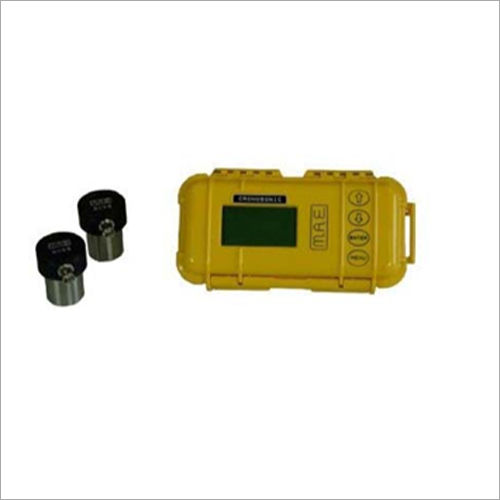
Ultrasonic Pulse Velocity Tester
50000.00 - 100000.00 INR/Piece
Product Details:
- Automation Grade Semi-automatic
- Port Size Standard connector for transducers
- Application Non-destructive testing of concrete structures
- Specimen Size Minimum cube size 100 mm or core diameter 100 mm
- Features Lightweight, Portable, Data Storage, Built-in memory
- Humidity < 90% RH non-condensing
- Interface Type USB and RS232
- Click to view more
X
Ultrasonic Pulse Velocity Tester Price And Quantity
- 50000.00 - 100000.00 INR/Piece
- 1 Piece
- Carrying case, Couplant gel, Charging adapter, Standard cable
- Automatic or Manual calibration
- Up to 300 test results
- Square waves
- Electric Pulse
- English
- Selectable, USB data transfer
- 230 x 120 x 60 mm
- Piezoelectric, 40 kHz
Ultrasonic Pulse Velocity Tester Product Specifications
- Up to 150 mm concrete width
- Up to 300 mm
- 1 second
- 0.1 s to 9999 s
- Multiple
- 40 kHz (standard transducers)
- Handheld/Portable
- Lightweight, Portable, Data Storage, Built-in memory
- Minimum cube size 100 mm or core diameter 100 mm
- Non-destructive testing of concrete structures
- Standard connector for transducers
- Semi-automatic
- Manual/Automatic
- Rechargeable Battery/230V AC, 50Hz
- USB and RS232
- < 90% RH non-condensing
- Up to 10 readings/sec
- Concrete quality assessment, Crack detection
- Ultrasonic Pulse Velocity Tester
- Approx. 3.5 kg
- 0C to 50C
- 1005000 m/s
- 0.1% of reading
- 7.4V Li-ion battery/230V AC
- Digital LCD Display
- 0.1 s
- Carrying case, Couplant gel, Charging adapter, Standard cable
- Automatic or Manual calibration
- Up to 300 test results
- Square waves
- Electric Pulse
- English
- Selectable, USB data transfer
- 230 x 120 x 60 mm
- Piezoelectric, 40 kHz
Ultrasonic Pulse Velocity Tester Trade Information
- 100 Piece Per Week
- 5-7 Days
Product Description
With an aim to stand tall on the expectations of our esteemed clients, we are providing Ultrasonic Pulse Velocity Tester. This tester is demanded to check the quality of concrete and natural rocks. Apart from this, we offer this Ultrasonic Pulse Velocity Tester in different specifications option in order to meet the diverse requirements and demands of the customers. This tester evaluates the quality and homogeneity of concrete materials.
Comprehensive Concrete Quality Assessment
The Ultrasonic Pulse Velocity Tester offers crucial insights into the integrity and uniformity of concrete structures. Employing non-destructive testing methods, it allows users to evaluate concrete quality, detect internal cracks, and ensure structural safety without causing any material damage. Its high-frequency pulse and advanced transducer probe provide consistency and reliability in readings for construction and civil engineering applications.
Advanced Features and User-Friendly Design
Designed for seamless on-site operations, this tester features an automatic/manual calibration mode, portable build, and intuitive LCD digital display. Its memory can store up to 300 results, catering to projects needing systematic data tracking. The selectable data output and USB interface ensure efficient data transfer, while the provided accessories, such as a carrying case and couplant gel, enhance convenience for mobile professionals.
Flexible Operation for Varied Environments
Functioning effectively in humidity below 90% RH and temperatures from 0C to 50C, the tester adapts to diverse testing environments. With options for rechargeable battery or AC power supply, and handheld portability, it provides flexibility and convenience. This versatility supports dealers, exporters, and contractors handling small or large projects, making it an ideal instrument for the Indian market.
FAQ's of Ultrasonic Pulse Velocity Tester:
Q: How does the Ultrasonic Pulse Velocity Tester assess concrete quality?
A: The tester transmits ultrasonic pulse waves through concrete using a 40 kHz piezoelectric transducer. By measuring the time taken for the pulse to pass through, it accurately assesses concrete quality, homogeneity, and detects internal cracks without damaging the structure.Q: What is the process for setting up and calibrating the tester?
A: Setup involves connecting the transducer, applying couplant gel to ensure proper contact, and selecting manual or automatic calibration mode. Calibration can be performed using reference materials, ensuring that subsequent readings are accurate and consistent.Q: When should I use manual or automatic calibration modes?
A: Automatic calibration is recommended for routine, fast measurements, while manual calibration offers greater control for specialized or critical tasks, such as when testing unfamiliar materials or achieving the highest level of accuracy in sensitive environments.Q: Where can this device be effectively used?
A: This tester is ideal for construction sites, laboratories, and field inspections where non-destructive evaluation of concrete structures is required. Its portable design and wide operating conditions make it suitable for diverse environments across India.Q: What types and sizes of specimens are compatible with this tester?
A: The tester supports multiple specimens, including cubes or cores with a minimum size or diameter of 100 mm. It can test up to 300 mm stroke and scan concrete up to 150 mm width, making it versatile for various projects and sample types.Q: How is data stored and exported from the tester?
A: Up to 300 test results can be internally stored. Data can be transferred conveniently to external devices via USB or RS232 interfaces, allowing for easy archiving, analysis, and reporting in selectable formats.Q: What are the benefits of using this ultrasonic tester in concrete evaluation?
A: It delivers rapid, accurate readings, detects flaws early, and avoids destructive testing. The device is lightweight, portable, and suited for large-scale use, saving both time and costs while enhancing the reliability of concrete assessment.Tell us about your requirement

Price:
Quantity
Select Unit
- 50
- 100
- 200
- 250
- 500
- 1000+
Additional detail
Mobile number
Email

Other Products in 'Mechanical Engineering Lab Testing Equipment' category

Contact Details

- B No. 51, Rama Road Industrial Area, New Delhi - 110015, India
ACCURATE SCIENTIFIC INTERNATIONAL
GST : 07ADUPA7135P1ZY
GST : 07ADUPA7135P1ZY

- Mr Parth Anand (Business Development Manager)
- Mobile : +919810080693, +919599580698
- accuratescientific51@gmail.com
- Branch Address : 1805 E Gwen Street, Phoenix, Arizona 85042
 Send Inquiry
 Send SMS
ACCURATE SCIENTIFIC INTERNATIONAL
All Rights Reserved.(Terms of Use)
Developed and Managed by Infocom Network Private Limited.
Developed and Managed by Infocom Network Private Limited.

