
 Send Inquiry


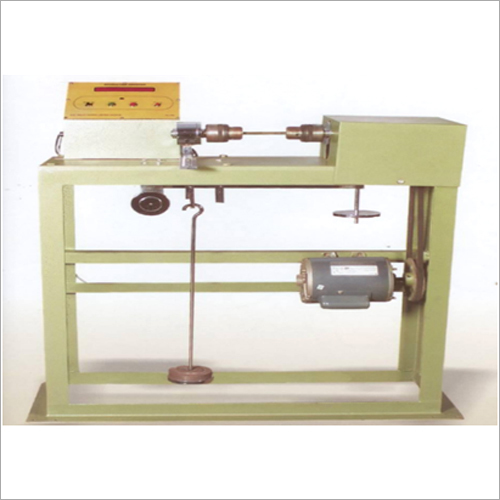
Fatigue Testing Machine
50000.00 - 100000.00 INR/Piece
Product Details:
- Measuring Range 10 Nm 400 Nm
- Humidity Up to 85% RH (non-condensing)
- Resolution 0.01 Nm
- Features Counter for Number of Reversals, Compact Design
- Application Fatigue Strength Testing of Metals
- Mounting Type Bench Top
- Display Type Digital Counter
- Click to view more
X
Fatigue Testing Machine Price And Quantity
- 1 Piece
- 50000.00 - 100000.00 INR/Piece
Fatigue Testing Machine Product Specifications
- Manual
- Up to 50 Hz
- Ambient to 40C
- Material Testing Laboratory, R&D
- Applicable for various hardness levels
- 0-400 Nm
- 2850 RPM
- 230V AC
- Rotating Beam Fatigue Tester
- Up to 30 mm
- Length: 100 mm, Diameter: 8 mm (standard)
- 230 V AC, 50 Hz
- Panel display
- 450 mm
- 10 Nm 400 Nm
- Counter for Number of Reversals, Compact Design
- Fatigue Strength Testing of Metals
- 175 kg (approx)
- Bench Top
- 100 kg/cm
- Standard for round or flat specimens
- 0.01 Nm
- Up to 85% RH (non-condensing)
- 1%
- Instantaneous (digital display)
- Digital Counter
- Semi-automatic
- Single specimen per test
- 0.25 HP, single phase
- Protective enclosure, Overload protection
- Quick jaw type
- Pre-settable revolution counter up to 999999 reversals
- 750 mm x 350 mm x 450 mm (LxWxH)
- Powder coated corrosion-resistant body
- < 75 dB
- IS 5075, ASTM E466
Fatigue Testing Machine Trade Information
- 100 Piece Per Week
- 5-7 Days
Product Description
We are engaged in offering a wide range of precisely designed Fatigue Testing Machine, that tests by measuring the force put onto the sample over many, many cycles until the sample fails. In order to maintain quality and avoid any type of flaw, Fatigue Testing Machine is tested on diverse quality parameter before final delivery. This test is generally performed to measure the reduction in stiffness and strength of materials.
Precision in Fatigue Testing
This rotating beam fatigue tester is engineered for precise measurement, supporting a test range of 10 Nm to 400 Nm with 1% accuracy and 0.01 Nm resolution. The machine accommodates standard specimen sizes and ensures repeatable, reliable results, making it a trusted choice for material durability assessment.
Comprehensive Safety and User-Friendly Operation
The fatigue testing machine features a protective enclosure, overload protection, and a quick jaw clamping system to promote both user safety and operational efficiency. Its semi-automatic control mode, digital counter with preset capabilities, and compact benchtop design make it suitable for busy laboratory and R&D settings.
Built for Durability and Compliance
Constructed with a powder-coated, corrosion-resistant body, this machine withstands harsh lab conditions. It meets IS 5075 and ASTM E466 standards for fatigue testing, ensuring that results are recognized internationally. Its robust build supports long-term, intensive usage with minimal maintenance.
FAQ's of Fatigue Testing Machine:
Q: How does the fatigue testing machine measure fatigue strength in metals?
A: The fatigue testing machine employs a rotating beam method, applying repeated stress to a single metal specimen while recording the number of cycles until failure. The digital counter tracks revolutions up to 999999 reversals, providing accurate data on the specimen's fatigue life within the range of 10 Nm to 400 Nm.Q: What safety features are included in this fatigue testing machine?
A: Safety is ensured through a protective enclosure that shields the user from moving parts and debris. Overload protection prevents specimen or machine damage during tests, while the quick jaw-type clamping mechanism enhances secure mounting and easy specimen changes.Q: When should this machine be used in a laboratory setting?
A: This machine is ideal for material testing laboratories and R&D facilities whenever there is a need to evaluate the fatigue strength of metals. It is suitable for routine quality checks, research experiments, and development of new metal alloys that require verified endurance specifications.Q: Where can this machine be installed, and what are its space requirements?
A: The compact benchtop design allows the machine to be conveniently installed on laboratory workbenches. With dimensions of 750 mm x 350 mm x 450 mm (LxWxH), it fits well in standard laboratory environments without occupying excessive space.Q: What is the process for conducting a fatigue test using this machine?
A: To conduct a test, securely clamp a single metal specimen (standard: 100 mm x 8 mm) in the quick jaw system. Set the desired test parameters on the digital counter, start the drive motor at 2850 RPM, and monitor the machine as it applies cyclic stress until specimen failure or the preset reversal count is reached. Results are displayed instantly.Q: How does this machine benefit material testing laboratories?
A: The machine offers precise, rapid assessment of metal durability with minimal operator effort thanks to its semi-automatic operation, digital counter, and quick specimen handling. Its robust and standardized design minimizes downtime and ensures compliance with international testing standards, benefiting quality assurance and research outcomes.Tell us about your requirement

Price:
Quantity
Select Unit
- 50
- 100
- 200
- 250
- 500
- 1000+
Additional detail
Mobile number
Email

Other Products in 'Strength Of Materials' category


Contact Details

- B No. 51, Rama Road Industrial Area, New Delhi - 110015, India
ACCURATE SCIENTIFIC INTERNATIONAL
GST : 07ADUPA7135P1ZY
GST : 07ADUPA7135P1ZY

- Mr Parth Anand (Business Development Manager)
- Mobile : +919810080693, +919599580698
- accuratescientific51@gmail.com
- Branch Address : 1805 E Gwen Street, Phoenix, Arizona 85042
 Send Inquiry
 Send SMS
ACCURATE SCIENTIFIC INTERNATIONAL
All Rights Reserved.(Terms of Use)
Developed and Managed by Infocom Network Private Limited.
Developed and Managed by Infocom Network Private Limited.

